Wool Sweaters

Modern textile technology has given rise to some purpose-specific fabrics with features like: wind-proof, breathable, wrinkle free, moisture wicking, scent block, and SPF.  As anglers, we now have performance clothing that allows us to fish longer and under a variety of conditions. I exploit high performance clothing while fishing.  But!  For me, there is no replacement for the warmth and comfort of my wool sweater during extreme cold conditions.

Fish360 Wool Sweater

I have several wool sweaters from Ireland that I wear while ice fishing and open water fishing in early spring and late fall.  The primary advantage that wool has over modern fabrics is that it’s the only material that will keep you warm when wet.  When in doubt, fish with wool. 😉

Facebooktwitterlinkedin

Chunking for Lake Trout

One of my goals for this year was to catch a lake trout. The best body of water to catch a lake trout from shore is Wachussett Reservoir. I fished several spots and exploited several methods. I learned something new on each trip and applied it on my subsequent trips. Today, it everything came together: fish on!

Fish360 Wachussett Reservoir Lake Trout

The first thing that helped me catch my first lake trout was my rod. The average rod length on the banks of Wachussett Reservoir is 7 feet. A 7 foot rod does not have enough length to propel a shiner or chunk to the distant holes where lake trout lurk. I use 9 and 10 foot St. Croix Mojo Surf rods. These rods propel shiners or chunks three times further than a 7 foot rod.

The second thing that helped me catch my first lake trout was a custom sinker. The sinkers used by anglers on Wachussett Reservoir range from 1/2 oz to 1 oz. I use a custom 2 oz sinker that I make using heat shrink tubing and two 1 oz steal bullet weights.

Fish360 Wachussett Reservoir Lake Trout

The third thing that helped me catch my first lake trout was the bait. I used a chunk of mackerel with secret sauce. The mackerel chunk was secured to a 7/0 in-line circle hook via elastic.

Fish360 Wachussett Reservoir Lake Trout

In addition to catching a fish on this trip, I also caught more knowledge. I am already planning my next lake trout trip to Wachussett Reservoir. I have mackerel! I also have yellow perch!! Lake trout beware!!!

Facebooktwitterlinkedin

Legends of the Salt

A legend is someone who has accomplished extra-ordinary things in a particular field. In “Legends of the Salt”, Charley Soares remembers 25 anglers who accomplished extra-ordinary things in saltwater fishing.

Fish360 Legends of The Salt

I have heard stories on some of the legends in this book. Reading Charley Soares personal stories on these legends has given me a greater appreciation for what they accomplished as anglers and their impacts on present day fishing. I also enjoyed reading and learning about other great anglers for the first time. The names of these legends are worth repeating. I think it’s purely a coincident that there are six Charlies on the list! 😉

  • Frank Woolner
  • Bob Pond
  • Bob Smith
  • Ralph Gray
  • Danny Pichney
  • Roland Coulombe
  • Curt Gowdy
  • Charlie Murat
  • “Uncle Arthur”
  • Joe Desrosiers
  • Jay Vee John Viveiros
  • Captain Larson
  • Charlie Cinto
  • Charlie Tilton
  • Charlie Haag
  • Tommy Togger
  • Jerry Hill
  • Tim Coleman
  • Bobby Bryder
  • “Magic Mike”
  • Frank Sabatowski
  • Bunnie Dipietro
  • “The Caretaker”
  • Charlie Soares
  • Stan Gibbs

The stories of these great men shall live beyond their days on the water because of “Legends of the Salt”. Whomever writes the second edition of this tile should include Charley Soares and present day women anglers who are taking our sport to a whole new level.

Facebooktwitterlinkedin

Heavy Metal

Metals (a.k.a. “tins”) are under-utilized by surfcasters. For deep water and wind-in-your-face conditions, I pull out the heavy metal.

Fish360 Kastmaster Deadly Dicks Crippled Herring Hopkins

My go-to heavy metals are: Kastmaster (3 or 4 oz), Deadly Dicks (3, 4, or 5 oz), Crippled Herring (3, 4, or 5 oz), and Hopkins (3, 4, or 5 oz). These metals are available in various colors and finishes. I like chrome, chrome/blue, chrome/green, green/yellow, and yellow. I dress all my metals with custom tied tails. The tails enhance the color profile and give more action. On my all-chrome metals, I change the color profile by simply replacing the tail. My journal entries confirm that metals with tails catch more fish than metals without tails. 😉

A Kastmater, Deadly Dicks, Crippled Herring, and Hopkins each has its own unique shape and weight distribution, which determines how far it casts, sinks, and how it moves through the water column.

Once for ounce, the furthest casting is the Deadly Dicks because it’s thin profile offers the least drag as it moves through the air. Once for ounce, the Kastmaster has the slowest sink rate because of it’s large surface area.

The running depth of a Kastmaster, Deadly Dicks, and Crippled Herring can be controlled by your retrieve speed. A fast retrieve will bring these metals to the top and a slow retrieve will swim these metals down low. When fishing from a sloping shore line, as your metal moves in closer, the height of the water column is reduced, so be sure to pick up your speed as the metal moves in to keep it at the desired depth.

The Kastmaster and Deadly Dicks have an top-to-bottom s-like swimming action. The Cripple Herring has more of a side-to-side swimming action. The Hopkins gives a wounded bait fish falling action as it’s jigged in the lower portion of the water column.

A metal lure costs less than a custom wooden plug. A metal out-casts a wooden plug, in any condition. Metals are more durable than plugs. Metals can fish the entire water column. Heavy metal catch BIG fish. Why are metals not over-utilized by surfcasters?

Facebooktwitterlinkedin

DIY Jig Bag

Modern plug bags have an attached pouch with slots for thin profile metals and small bucktails.  This is a great option.  But!  If you are fishing 4, 5, and 6 oz bucktails or 4 and 5 oz Kastmaters, Deadly DicksHopkins, and Crippled Herring, then you need another storage solution.

DIY Jig Bag

All you need to make your own jig bag is a plug bag and 1.5″ diameter SDR PVC pipe.  Using a power miter saw with a stopper, cut enough PVC pipe lengths from the PVC pipe to fill your plug bag.  I cut 4.5″ lengths for bucktails and 8″ lengths for metals.

Fish360 DIY Jig Create

Remove the plug tubes from your plug bag and replace them with the 1.5″ diameter SDR PVC tubes.

DIY Jig Bag

I have re-purposed my two 3-tube plug bags into a bucktail bag and a metals bag.  I am always packed and ready to go, regardless of where and when I fish.  Time is fish!

Facebooktwitterlinkedin

Fall Frogging

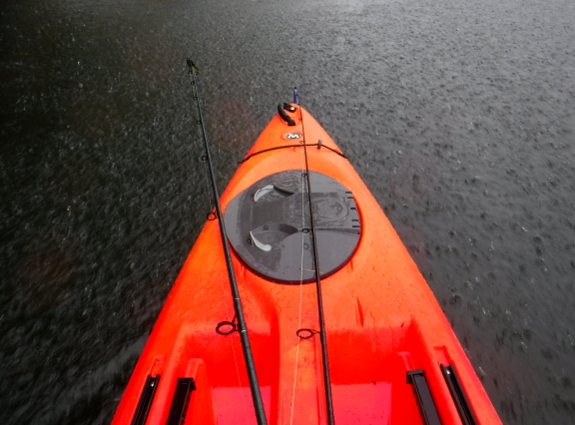
Fall is a great time of year to target a multitude of species.  Fish are feeding before winter takes hold.  Today I had the opportunity to go fall frogging.  I rigged up five rods. Four had frogs. One had a Gary Yamamoto senko.  I hooked and landed two fish on frogs.

Fish360 Fall Frogging

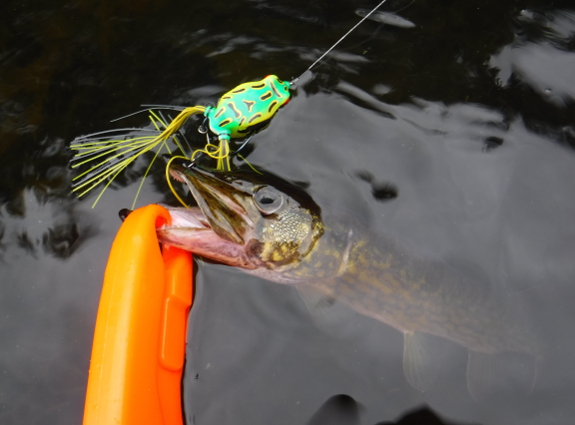
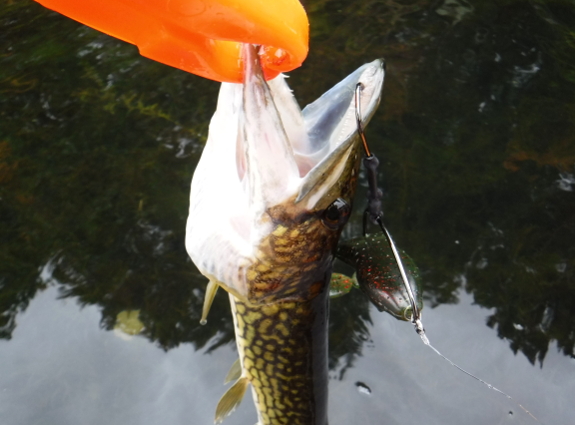
As I moved through the Ox Bow, I rotated through my rods and worked each piece of structure.  The sky was overcast.  No one else was on the water.  The air was deathly quite.  As I slowing swam my frog over the remaining vegetation, a fish exploded on my frog.  My rod instantly bend over.  My reel started to lose line as the fish pulled drag.  Bass?  No.  Chain pickerel!

Fish360 Fall Frogging

I continued working my frogs on each subsequent piece of structure in the Ox Box.  A second fish exploded in my frog and missed the hook.  I grabbed another rod and worked a different frog.  Nothing.  I grabbed another rod and fished another frog…fish on!   Bass?  No.  Chain pickerel!

Fish360 Fall Frogging

There was a third fish that pulled down one of my frogs like a freight train.  Line was being pulled off my spool faster than I could reel it in.  The fish swam into some a structure.  I could not longer move it.  As the kayak started drifting towards the anchored fish, the line went slack.  Bass?  Pickerel?  Pike?  Not sure.  But, this fish now haunts my dreams.

On this trip I learned that frogs are not just for bass!  Chain pickerel are genetically related to Northern pike.  Next time I target pike, I am bringing frogs!!!

Facebooktwitterlinkedin

Fish360 Journal Goes Open Source

The Fish360 Journal project started as a single person project with an innovative idea beyond the reach of technology. As technology evolved, so did the project. Our newest evolution is the transition to open source.

Fish360 Journal

If you would like to work on novel visualization models and innovate usability paradigms, drop us a line. If you have an idea for a new feature, drop us a line. If you would like to integrate with another service, drop us a line.

Facebooktwitterlinkedin

Grip Studs

I have been using a pair of Korker cleats for years. During my last trip to Cuttyhunk Island, I lost a cleat after being knocked off a rock by a wave.  Korker now has boots with studs.  But, my Simms boots still have a lot of steps left in them.  So, I order a set of Grip Studs.

Fi

Mounting the #1800 Grip Studs to your boots is easy.  All you need is the stud tool and a power drill.  Before you drill, define a pattern that will distribute your weight evenly across all of the studs.  This will enhance your balance and reduce pressure points.

Fish360 Grip Studs

I field tested my new traction control system on a precarious rock formation that extends far out from a sandy beach.  They grip!  The barnacles, seaweed, and relentless waves were no match!!  I never lost my footing!!!

Grip Studs just work.  It’s that simple.  The unexpected benefit of using Grip Studs instead of Korker cleats is increased fishing time.  All I need to do is tie my boots and I am ready to trek over rocks with sea weed dread locks. 🙂

Facebooktwitterlinkedin

Surf Sharking

I took a couple of friends surf sharking during the August full moon. On the way to my spot, we stopped in at Red Top Bait and Tackle and picked up 18 fresh menhaden (1 menhaden per hour per angler). The night was overcast. We never saw the moon the whole night. This proved to be a good omen.

Fish360 Surf Sharking

When we got to the beach, I read the water. I found a very subtle current line that was forming based on the incoming tide, the beach structure, and the wind direction.

Fish360 Surf Sharking

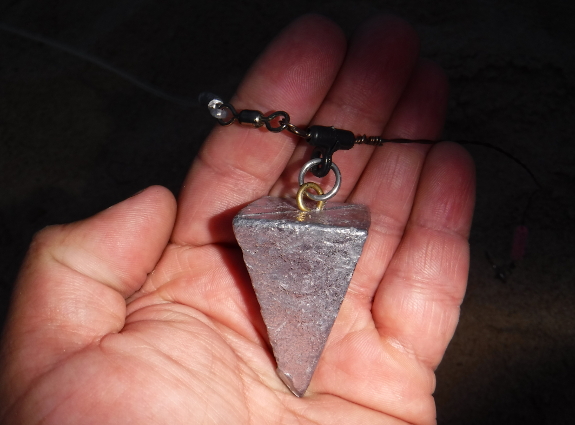
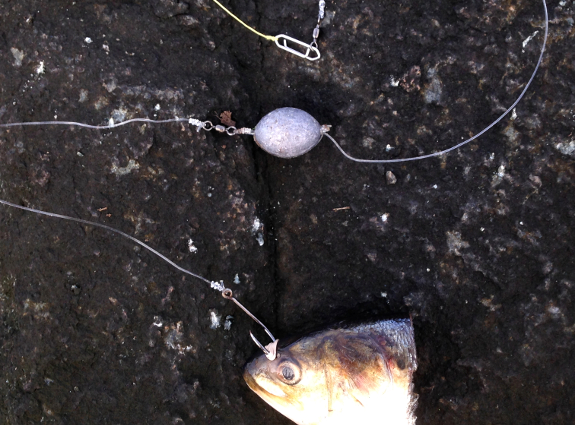
To reach the current line, you had to have a stout rod to propel 5+ oz of lead and bait. To hold bottom, a pyramid sinker was needed. A pyramid sinker is not aerodynamic. A stout rod and proper casting technique will only propel a chunk of meat and lead so far. For maximum distance (and in our case to reach this current line) you need a chunking rig optimized for distance. My custom surf shark fish finder rig got our fresh chunks of menhaden into the strike zone!!! 🙂

Fish360 Surf Sharking

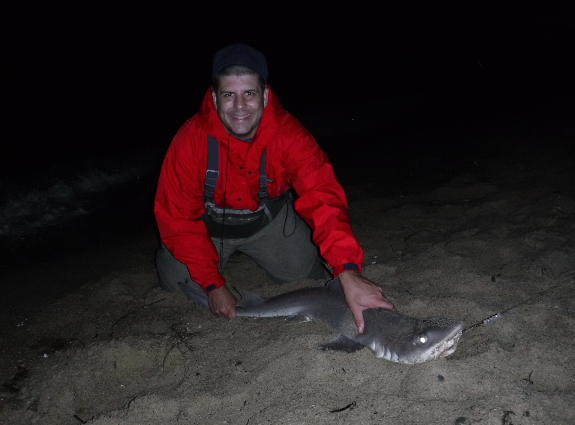
Bare hooks do not catch fish. We checked our bait every 15 minutes. If it was partly eaten, we replaced it. No exceptions. Fresh bait = fish. Big bait = big fish. We caught fish during the entire incoming tide. Fourteen sharks in total.

Fish360 Surf Sharking

Our trip was cut short when the sporadic showers turned into heavy perpetual rain that turned the smooth sandy beach into Swiss cheese. The head shaking and drag pulling sharks gave us memories. Life is short. Take a friend fishing.

Facebooktwitterlinkedin

Chunking Inlets

Inlets condense the water column and flush bait fish from the back bay, salt pond, or river during an outgoing tide. Large predatory fish hence frequent inlets for free meals. That is, meals delivered to them via current for which they expend minimal energy. The most productive way to fish inlets is to cast up current and work the water column as your presentation drifts down current. This repetitive process is a proven and widely exploited method with artificials: plugs, jigs, metals, and plastics. Ironically, not with chunks.

Fish360 Canal Chunking Rig

To properly drift a chunk in an inlet, you need a rig that will cast far, drift, and not snag the bottom easily. I have developed a new rig that I call the “Canal Chunking Rig”. This rig uses a Tactical Anglers clip, two Krok 310 lb swivels, 80 lb mono, and a 4, 5, or 6 oz sinker. This rig is not commercially available. Making this rig takes time. But, it’s time well spent. Here is how I make this rig.

  1. Tie a 40″ length of 80 lb monofilament to a 175 lb Tactical Anglers clip via improved clinch knot.
  2. Tie a 310 lb Krork swivel on the other end of the line to form an end-to-end length of 12″.
  3. Tie a 60″ length of 80 lb monofilament to the other end of the 310 lb Krork stainless steel swivel. Be sure to leave a long tag (e.g. 12″ long).
  4. Slide an egg sinker (e.g. 4, 5, 6, or 8 oz) through the line and the tag end.
  5. Loop the tag end back through the egg sinker and tie two overhand knots on the tag end to secure the egg sinker.
  6. Tie a 310 lb Krork stainless steel swivel on the other end of the line to form an end-to-end length of 24″. This will give you a Canal Chunking Rig with a approximate total length of 40″.

I make 4, 5, 6, and 8 oz rigs Canal Chunking Rigs. I pre-rig my chunks on my hooks and slip them on and off the Tactical Anglers power clip. I also re-rig based on the current speed and the depth that I want to drift my chunk at. I tend to bounce my chunk across the bottom. But, when the fish are suspending and not staged behind structure, I will drift chunks throughout the entire water column. Time is fish!

Holding bottom with a castable sinker in an inlet with water moving at 5 knots is impossible. Go with the flow! Cast your chunk rig up-current and fish the drift. The predators are looking for meat. Feed them meat!

Facebooktwitterlinkedin