Bass Class 2010: New England

I attended the Plum Island Surfcasters fishing show this past February, which hosted DJ Muller.  DJ gave an awesome presentation on wet suiting.  I just learned that DJ and Dave Anderson have crafted an eight hour class on striped bass and surfcasting: Bass Class 2010 ~ New England~.

If you are a novice or an intermediate surfcaster and you would like to take you fishing up a level, then attend the Bass Class.  This class is the most comprehensive class on surfcasting for striped bass and it’s going to be off the hook.  Trust me!

The class will cover:

  1. Surfcasting History
  2. Striped bass biology: spawning, reproduction, and migration
  3. Equipment
  4. Techniques: eels, chunking, bait, snag and drop, and artificials
  5. Plug Building History
  6. Understanding lures and how and when to use them: pencil poppers, red fins, shads, and jigs.
  7. Striper Variables: tides, moon phases, wind, and time of year
  8. Reading the water
  9. Bait fish patterns and movements
  10. Finding Stripers
  11. The mental and physical approaches to surfcasting
  12. Cape Cod Canal Basics

The segment on Finding Stripers will be an in depth discussion with pictures and illustrations on what to look for and how to read water.  In addition to these topics, there will also be workshops on how to load Red Fins and Super Strikes and how to rig Slug-Go’s and eels.

The Bass Class is being held on Saturday, September 4th from 8:00 AM to 4:00 PM at The Saltwater Edge in Middletown, Rhode Island.  The class costs $125.00 per person.  But, as a Fish360 blog reader, you can attend the class for only $100.00; and if you bring a friend, you and your friend can attend the class for only $75.00 per person.  As an attendee, you will also receive a notebook and a Bass Class T-Shirt.  Now that’s fishconomic!

Seating is limited, so register today by sending DJ an email (be sure to mention this blog article) and a non-refundable $50 deposit. So, am I attending the class?  Absolutely!  If you knew a blitz was going to happen, would you miss it?  I hope to see you there.

Facebooktwitterlinkedin

Striped-Bass.com

I was fishing one night when I bumped into a fellow surfcaster working pencil poppers.  I asked him: “Any luck?”.  To my surprise, he replied “Just a dozen schoolies”.  During our conversation on night time versus day time plugs, he mentioned that he hangs out on “SB”.  “SB, what’s that?”, I asked.  He replied “striped dash bass dot com” and then vanished into the dark.  I did not catch any fish that night, but I did catch S-B!

Striped-Bass.com is an online community (based in Rhode Island) that was started in 2000 by John Redmond (Handle: JohnR).  Two ways to participate in this active community is via forums and events.

The forums are a great way to interact with other members and learn.  If you are new to S-B, then I would suggest posting in the Meet & Greet forum and then wade slowing into the Striper Talk, the main forum.  Read some posts. Search before asking questions.  Comment on existing threads.  And then create your own threads.  But, keep in mind that online communication is not the same thing as face-to-face communication— lots of visual and non-verbal information is lost in translation.  The Plug Building forum and the Rod Buildingforum are two additional forums that you can cast into and retrieve some great knowledge.  Although you can learn a lot from these forums, do not forget:

“Knowledge is earned and shared – not instantly downloaded.” — JohnR

S-B has “formal” and impromptu events year round.  The events are attended by anglers from nearby states like Vermont and from distant states like California.  The two go-to events during the off-season are Plugfest and TFCTFN, which host 100+ members.

Plugfest is a grass-roots show where plug builders from all experience levels can display their hand crafted lures and exchange ideas and experiences.  The thing that makes this event unique is its purpose: to celebrate the work, skill, and ingenuity of lure builders from near and far.  The lures at Plugfeast are truly amazing creations that simply must be seen and held to be fully appreciated.

TFCTFN is an annual dinner / entertainment night.  This event gives members a chance to wish away Old Man Winter and turn towards a new season.

During the season, it’s all about fishing.  There are fishing trips to Cuttyhunk Island, Cape Cod, Narraganset, and Plum Island.  There are also many impromptu fishing trips organized via private messages (PMs).

If you want GPS coordinates to the best hot spots, then join another community.  If you want to learn what works and what people really think of fishing gear based on their direct experience with the products (reels, rods, plugs, etc), then join S-B.  If you want to fish with avid anglers in the Northeast, the join S-B.  If you would to be part of a community who is passionate about fishing, then join S-B.  I hope to see you on S-B.  My handle is Fish360.

Facebooktwitterlinkedin

AquaPac Water Proof Bag

I was wet wading with a friend on Craine’s Beach in Massachusetts. We started fishing before sunrise. As the sun started to rise, a fish rose up and smacked a Stillwater Lures Smack-it popper. The fish was pulling line like the drag was not set. We were waist deep, so we waded back to the beach. We had no idea what fish was on, but we knew it was big. After some tough give and take, my friend landed the fish: a 15 pound bluefish whose girth had gator-like proportions! My friend pulled out his mobile phone to take a picture and to his unpleasant surprise the phone was swimming in sea water. The “water proof” bag he bought to protect his electronic devices failed! Unacceptable.

Fish360 AuquaPac

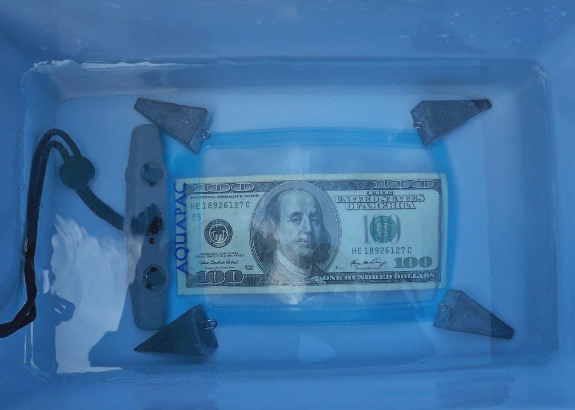
The following day I was in Maine motoring through the Kittery Trading Postwhen I noticed the same “water proof” bag that failed my friend and a bag by AquaPac. I purchased the AquaPac. But, before I could recommend it to my friend, I tested it. I placed a dry $100.00 USD bill inside the AquaPac and held it below water via 16 ounces of lead:

After 36 minutes, I removed the AquaPac and recovered my money. The AquaPac kept my $100.00 USD bill 100% dry! I now use the AquaPac during my fishing trips and when I go to the beach. I may forget my bait or sunscreen, but I cannot afford to forget my AquaPac. ;-).

Facebooktwitterlinkedin

The Art of Surfcasting with Lures

I started surfcasting by casting bait into Poseidon’s waters.  When I transitioned from bait to plugs, I fished plugs every wrong way possible.  I even invented a few new wrong ways to fish plugs. ;-).

The Art of Surfcasting with Lures

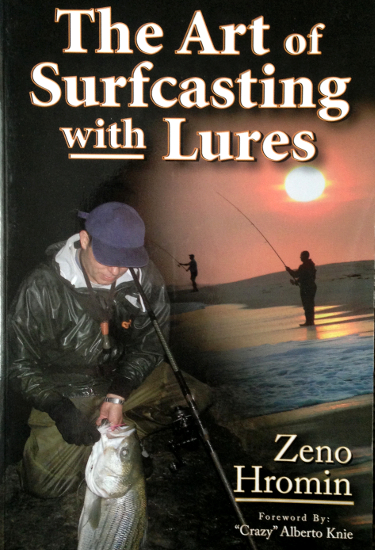
Since my countless casts returned plugs without fish, I ordered The Art of Surfcasting with Lures by Zeno Hromin.  The book overflows with knowldege from the surf.  Personally, I learned how to select the proper rod, reel, line, and lure based on the conditions, current, depth, time of year, and the structure I am fishing.  I also learned how to properly present:

  1. Darters
  2. Needlefish
  3. Popping Plugs
  4. Metal Lip Swimmers
  5. Eel Skin Plugs
  6. Plastic Swimmers
  7. Soft Plastics
  8. Bottle Plugs
  9. Tins
  10. Teasers

After reading Zeno’s book, I started catching quality fish.  Coincidence?  The number of keeper striped bass on lures in my fishing journal suggests: No.

Facebooktwitterlinkedin

Plug Management: Wall it!

As surfcasters we must be prepared for various water depths, changing current velocities, wind, and fish with unpredictable appetites.  As a result, the number of plugs in our arsenal explode to military proportions.  Hence, the birth of plug management solutions.

Two widely used plug management solutions are milk crates with tubes and large Plano boxes.  These two solutions can store and organize countless plugs.  But, I have been searching for a day-to-day solution that allows me to quickly see and select my plugs for my next fishing trip and to dry my plugs after their fresh water bath removes the corrective sea salt.

This past June I was at the Cuttyhunk Fishing Club with some members from S-B.com talking through the daylight hours and the topic of “plug management” came up.  My friend Bruce May, who builds fine custom furniture at  B & M WoodWorking, suggested setting up wire lines on a wall  to  hang plugs— like wet clothes on a clothes line.  Building on Bruce’s idea, I installed a peg board on the wall of my garage and created “plug lines” using peg hooks and wire:

Fish360 Plug Management

Setting up a Plug Wall is inexpensive and easy.  All you need is:

  1. A 4′ x 8 ‘ sheet of peg board
  2. A box of 1 5/8” galvanized course screws
  3. 24 double-prong peg hooks
  4. Wire (e.g. 12 gauge insulated electrical copper wire)
  5. A power drill
  6. A pair of wire cutters/pliers (e.g. Lineman Pliers)

When you insert the peg hooks side-ways, be sure to insert them in such a way that when the wire “pulls” on them, they “push” back:

Fish360 Plug Management

Also, be sure to insert a peg hook mid-line to keep the plug-line straight while under load:

Fish360 Plug Management

In addition to storing plugs, the Plug Wall can also store jigs, tins, and rigged soft plastics.  My Plug Wall allows me to spend more time fishing and less time “managing” my day-to-day plugs.  Thank you for the insight Bruce!

Facebooktwitterlinkedin

Striper Tales

I have had the pleasure of reading many of the books written on our striped friend: Morone saxatilis.  A novel addition to the striper literature is Striper Tales, a collection of fishing stories.  The stories are so well written that reading them feels like they are being told by the anglers themselves.  As I listened to the forty six stories, I traveled from the jetties of Jersey, to the notorious rocks of Mountank, to the Rhody rocky shore, and to Bassachussets.

Thank you Paul Haertel, Jim “Murty” Murtagh, Mark Jollife, Nick Honachefsky, Bob Misak, Joe Pallotto, Stan Dziedzic, Allen D. Riley, Geoff Turner, Edward M. Greenberg, Frank Blasko, Bill Lellis, Larry Welcome, Pete Burawa, Mike “Saltheart” White, Kadir Akturk, Thomas Oswald, Gary Soldati, Rob Cerny, Tony Machado, Al Ristori, Andre Velez, Mike DeSimone, Tony Stetzko, Dave Anderson, Alan Cordts, Ken Zwirko, Don Guimelli, and DJ Muller for capturing these stories before they vanished with the tides of time.

The tide waits for no one.  Turned off YouTube.  Stop texting.  Unpluged Twitter. Go fishing with a friend and make your own striper tale.

Facebooktwitterlinkedin

New England Saltwater Fishing Show

I attended the Rhode Island Saltwater Anglers Association’s annual New England Saltwater Fishing Show this month for the first time.  Getting to the Rhode Island Convention Center was easy.  Parking was plentiful, secure, and reduced for the show at the center’s garage.  No need for commando parking tactics.

When I got to the ticket counter, I handed the sales person the online coupon that I printed; and as advertised, I got one dollar off admission.  One word describes the ticket counter: speedy. I arrived in the exhibition hall a half hour before the seminars started, to secure a good seat.

I attended the “Kayak fishing for big Stripers” seminar by Bob Oberg and Dave Giuliano.  The seminar was well structured and full of great tips derived from many hours on the water.  I am new to kayakfishing, so I learned a lot; but, even the kayakfishing masters learned a few things.  After the seminar, I visited the boths.

The “cool booth” award goes to Striped-Bass.com (a.k.a. S-B). The booth was inviting.  There were beach chairs, a large LCD displaying pictures from last year’s events, and of course the “hola dancer”.  The both was a great way to connect up with other S-B’ers and plan for The Striper Cup.

The “WOW! booth” award goes to the CMS booth, which had more sticks than the George Washington Memorial State Forest.  A very good thing!   Without question, the CMS folks really know their rods.  They ask you some questions, listen to the way you fish, and then suggest the optimal rod specific to your method and application.

The show is a very efficient way to shop for plugs: the local plug craftsman are in one place with their latests creations fully dressed and accessorized.  I turned by brief case into a plug bag and stuffed it with tasty offerings from Saltybugger, BigFish, Afterhours, Lemire’s Plugworks, Line Stretcher, Roberts Lures, and Point Jude Lures.  Next year I am bring my wading belt and empty plug bag. ;-).

I was impressed with the organization of the show, the number of content rich seminars, and the wide spectrum of vendors: plugs, kayaks, rods, reels, books, charters, etc., etc., etc..  And at nine dollars, the show ranks very high on the fishconomic scale.  Kudos RISAA!

Facebooktwitterlinkedin

My First Ice Fishing Trip

also watched some On The Water TV episodes. More specifically:

  1. Ice fishing for trout and salmon.  On The Water TV. Season 1, show 8.
  2. Ice fishing for perch, bass, pickerel, walleye and pike.  On The Water TV.  Season 3, show 7.
  3. Ice fishing East Grand Lake in Maine: lake trout and salmon.  On The Water TV.  Season 4, show 2.

After reading these articles and watching these DVDs, I learned that ice fishing is pursued by anglers of various persuasions and is not unlike other types of fishing.  Like each type of fishing, the gear is specialized; but the techniques are similar. For example, fishing around structure and knowing where your presentation is in the water column are critical parameters of success.

After learning how to ice fish safely, my next step was to build my ice fishing tackle box.  Like other methods of fishing, there are an overwhelming number of products and electronics devices.  But, the basic ice fishing gear is just a sled, tip ups, rigs, bait, and something to make a hole through the ice.

There are several sled options from open ice fishing sleds that can transport all your gear to specialized sleds with integrated shelters and seats that expand and collapse.  Some anglers build “Hummer” and “Cadillac” style sleds using old skies.  For my first time out, I used a simple down-hill snow sled.

I personally do not use low cost/low quality rods when targeting trophy fish. So, when I was in the Scarborough, Maine Cabela’s, I inspected all the tip-ups and consulted with one of Cabela’s finest, who is a local ice angler, to find a “built to last” tip-up that would performe well under pressure and was easy to use.  I purchased a set of Jack Traps tip-ups because of their simple design and quality of construction.  And I am so glad I did!!!

There are several ice fishing rigs. The rig that I pre-tied for my trip consists of a 24 inches of 10 lb flurocarbon leader with a double surgeon’s loop knot on one end, a size 4 Gamakatsu octopus hook (stock# 02308-25) on the other end, and a slit shot sinker at midpoint. I also tied a double surgeon’s loop knot on the main line to connect my rigs via loop-to-loop knot.  After building my ice fishing tackle box, I was ready for my first ice fishing trip. I called and emailed my friends to coordinate the final “details”.

The day of the trip, I got up at 4:00 AM; dressed in layers (Under ArmorColdGear top and bottom!); packed my sled; and pickup my friend on the way to the lake.  We arrive at the lake before sunrise, along with our other friends. Using a pair of work gloves, I used my friend’s power auger and made all our holes at once. We lowered our baits and set them at different heights to determine where in the water column the fish were feeding. Fish move and are not always where we think their suppose to be!  Some of our tip-ups had live night crawlers and some had live shiners.

I am not sure if the fish in the lake were snobs, but they did not touch my fresh wiggling night crawlers.  I started to second guess my method, and then, my friend screamed: “FLAG!”, with his distinct Canadian accent.  I think I set a world record for sprinting on ice without falling.  I retreived my line until an aggressive and slippery pickerel came up through ice.  This specimen was not the Loc ness monster, but it was a respectable fish.

This was my first ice fishing trip, but now I am hooked and in the market for my very own power auger.  If you are new to ice fishing and would like to try it, then join a club like the Plum Island Surfcasters or an online community like striped-bass.com, who have annual ice fishing trips.

Facebooktwitterlinkedin

The Fly Rod Chronicles

Reading The Fly Rod Chronicles is a pleasure. In chapter one, Landerman casts his line. In chapter two, he sets the hook. In chapter three, he starts his retrieve.  As Landerman pulls you in, he shares stories about his childhood fishing adventures, his uncensored views on fishing politics, his near death experience, his family fishing trips, SWAMBO, and George. He also captures the essence of fly flying. Fly fishing is not just about catching fish for food or modeling catalog merchandise to fashion-ignorant trout. Fly fishing is about learning, playing, mastering an art, and teaching others this art.

I must disclose that although I was released at the end of the last chapter, I am now hooked on fly fishing. I am in the market for my first fly rod!

Tempus fugit. Fly fish.

Facebooktwitterlinkedin

Reel People: Fisherman of Plum Island

I recently had the pleasant surprise of opening a gift and discovering:

Reel People: Fisherman of Plum Island by James Waldron is true to it’s title.  The film captures genuine stories from 60+ reel people. The stories are easy to listen to, but difficult to forget.  The art of Waldron’s film is how the stories and photographs are weaved into a continuous script that hooks you immediately and pulls you in until the end.

Waldron’s film provides a 360 degree view of fishing on Plum Island, Massachusetts. There are Beach Buggy fisherman, Boat fisherman, and Surf fisherman. There are foreshadows of the new breed of PI fisherman: kayak fisherman. There are scientists explaining their research in plain terms. There are exemplary surf-transport solutions that move gear up and down the soft sand with ease.  My favorite is the little red wagon with “Big Foot” wheels.  There are beautiful aerial scenes that provide great reconnaissance information for the bass hunter. And lastly, there are photographs of BIG fish past and a vintage film that helps penetrate through the last 47 years of Plum Island history: “A Day to Remember“, edited by Bob Smith (circa 1960).  All this great content in 62 minutes, kudos Waldron!

I personally liked the scientific perspective, because of my background. More specifically, the scientists (who also fish!) are using telemetry data to learn how striped bass move and utilize an estuary; in particular, how their eating habits relate to measurable parameters such as temperature, tide, and lunar cycle. The goal is to exploit all this data to predict how striped bass will impact the bait fish in an estuary. I would hypothesis that the same data my also yield the inverse; that is, how the amount of bait fish in an estuary will impact the population of striped bass.

Fishing is not just about catching fish. It’s about playing in the water without thinking about life’s obligations. It’s about the people you get to know during your trips and the stories you build together. In my humble opinion, Reel People captures this human element, something few films realize. The tides will continue to change. Life will go on. But, the stories of the Plum Island fisherman will continue to breath via Reel People and Kay’s scrapbook.

“Once you get the sand of Plum Inland in your shoes, you’ll never get it out.” – “Reel People: Fisherman of Plum Island”.

Facebooktwitterlinkedin